




Just in time for the first few weeks of class! 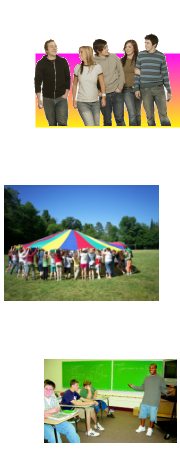 Our editors have handpicked more than 25 of our favorite icebreakers and group activities and have provided free instructions. These icebreakers are simply the best, and we’ve played them all personally. Try ‘em out and let us know how they work out for you!
Icebreakers by group size
Small group
Games for 2-5 people
Icebreakers for Small Groups (2 to 5 people)
Icebreakers, Games, Activities Guide:
A: Active
G: Get-to-know-you
T: Team building
Medium group
Games for 5-10 people
Icebreakers, Games, Activities Guide:
A: Active
G: Get-to-know-you
T: Team building
Large group
Games for 10-30 people
Key:
A: Active
G: Get-to-know-you
T: Team building
Extra Large group
Games for 30 or more people
Icebreakers by category
Active
Action packed icebreakers that might
cause you to break a sweat!
Get-to-know-you
Icebreakers that help people get to know each other.
Team building
Activities to build teamwork and unity.
Introduction:
In several of the documents on this web site, "Training By Doing," was recommended. We learn by reading, listening to someone talking, watching something being done, and doing something ourselves. Of course, different individuals have different ways of learning, and variable strengths according to how they obtain the information to be learned. This list is a rough generalization.
If you look at the various ways we have of learning, then reading appears to be at the bottom of the list. The information is difficult to absorb and understand, and retention tends to be short lived. Listening to a lecture appears to be far down on the list, almost as low as reading. Watching something being done, live, or video or on a film, is a little more effective – best if it is live. At the top of the list, when the trainee participates in the activity to be learned, absorption is faster, more complete and more concentrated, and retention is much greater.
In a classroom or workshop situation, however, it is not possible to exactly replicate a genuine field situation in which trainees can participate. That is one of the many reasons why training should not be all lumped together and the facilitator or mobilizer then expected to perform in the field.
After doing some field work, mobilizers should be brought back to a training centre, allowed to share experiences, and obtain more training based upon what they have already done. Routine and regular follow-up training should be a standard element of all programmes for facilitating mobilization, capacity development, poverty reduction, management training and income generation.
Meanwhile, there is another, simulated form of participation that can be conducted in a class room, a workshop or training session. Role playing or simulation games have been found to be very effective. Such simulated participation should be used in the training of your facilitators and mobilizers, and used by those same facilitators and mobilizers in their work of capacity development, community mobilizing, income generation, and management training.
The Essence of a Role-Playing Game:
A role playing game is a training session where the facilitator, perhaps with an assistant or two, sets up a scenario where the participants are assigned different roles, where those roles identify with those in the situation where participants will find themselves when they undertake their work in the field.
The play gives the training participants opportunities to act out various roles chosen to represent actual roles that would be in the field situation.
One important result is that training participants get an opportunity to see the field situation from perspectives other than those they might be taking in reality. That opportunity results in a greater sensitivity to the experiences of other persons in the field situation.
The follow-up session following the play gives the training participants an opportunity to analyse some of the social dynamics that occur. This objectivity is available both to those who take roles for a play session, and to those who might be observing the role-play session.
There are three stages to a standard role-play session: (1) the set up, (2) the play, (3) the discussion.
Setting Up the Play:
In the set up stage, the facilitator sets the stage. This means describing the scenario and assigning roles to participants.
If a participant plays a particular role in reality, in the field situation, it would be more effective to give a different role to that participant during the role-play session.
An optional part of the set up stage is to give some time for the key role players to get together to map out the general plot of their play. You as facilitator must decide this on the basis of what you want to emphasize, and this should be decided when you design the workshop in which the role-play will be carried out.
Another option is to put together a single page description of the scenario to be worked out by the players. Another option is to write one-paragraph descriptions of the key role players. A description can include the main objectives and concerns of the person in that role, perhaps can include some key dialogues or a statement to be read by the person playing the role. The possible variations are numerous; use them.
Alternatively, it may be useful for the persons playing all the roles to be spontaneous and think up their separate acts in the heat of the moment. In this case there will be no time for the actors to plan their plot, and no written descriptions or guidelines.
The Play Stage:
The second, or play stage of the session is when the trainee participants act out their roles and the play is carried out.
If the play becomes too long, then the facilitator can give the actors a time warning of one or two minutes, and then end the play after that.
Alternatively, the play may be too short, and the facilitator must encourage the actors to embellish their acting, and to add speeches, a soliloquy and actions that make their play less skimpy.
The Follow Up:
The third stage is the follow-up. This is important and can not be omitted.
It is important for all the trainee participants to discuss what happened. They may question individual role-players to ask why they took a particular position, made a certain statement, or undertook an action. The explanation and the resulting discussion is important for the participants to obtain a greater understanding of the social dynamics related to a particular field situation.
In some role play sessions, a certain amount of heat (anger, dismay, disagreement) may be generated, especially if some role-players take the play too seriously, and take hard line positions. The follow-up discussions offer the facilitator an opening to cool off the group a little, and explain that the heat was generated by the structure of the situation, not by the stubbornness (or evil) of the individuals playing the roles.
That heat is not a bad thing to be avoided; it is an opportunity to reveal the nature of some field situations, and to encourage participants to be sensitive to the different assumptions, values, goals and positions that may be taken by different persons actually in the field.
The Value of Humour:
In both the set up and the discussion stages, the facilitator should encourage a light touch. Remember that a "play" by definition is not reality, and should not be taken seriously. Humour is encouraged.
Humour can defuse an anxious situation, and it allows participants to take a more arms-length approach to analysing the potential field situations they might experience later.
Participants should be encouraged to "ham it up," (play with their roles; over act), and to enjoy playing.
When to Use Role Playing:
As mentioned above, role playing games should be used in the training of mobilizers and facilitators, and used by mobilizers and facilitators in their work in the field. Role playing should not be limited to initial training or awareness raising sessions.
They are very useful during annual and semi-annual reviews of various programmes. They are useful in follow-up and ongoing training of community workers after they have been in the field for some time. They are useful for heads of programmes, managers, programme managers, planners and head office staff and officers, especially if they can be included in sessions along side of field workers in the programmes they administer.
In a single training session or workshop, you may wish to set up more than one role playing game. If so, make it different, using a different scenario, and with different structure (eg whether or not you hand out written instructions; whether or not you give time for the players to prepare their plot; whether or not you use all or some of the participants).
Simulation Games:
Simulation games are more elaborate than simple role playing. Perhaps one of the earliest simulation game, developed for a class in political science, is "The Power of Suns."
One of the most elaborate simulation games was one funded by CIDA, held on Camp Shylo, a military wilderness area in southern Manitoba, where a hundred or so secondary students from across Canada were set up in five "nations," with various characteristics, with facilitators and chaperones, equipped with radio handsets, in a game that lasted several weeks.
Relative to the output, the raised awareness of participants, perhaps the elaborate setting up of simulation games does not warrant them being used in training of and by facilitators and mobilizers in community mobilization, poverty reduction, capacity development and income generation. *
Conclusion:
During training workshops and routine reviews, role playing games are an effective method of increasing awareness, enhancing participant analysis of field situations, and familiarizing participants with the roles, aims, perspectives and positions of people whom they will meet in the field.
While not directly participatory in the sense that they are real situations, they are participatory in their implementation, and provide considerable and valuable benefits in a training programme.
Playing Roles:
 |
by Nigel S, Nov 9, 2007 | |||||||||
Online resources to stimulate and develop your brain. Have fun whilst training your mind to excel.You have probably seen media reports about the emerging understanding of the benefits that mental exercise brings. Studies have shown that a routine of mental activities can increase your alertness, agility of thought and creativity. Your brain's health is an important contributor to your quality of life as you age and there appears to be a correlationbetween your level of mental stimulation and your risk of dementia/Alzheimer's in later life.
|










 RSS Feed (xml)
